How to Meditate: 7 Steps to Peace, Clarity, and Healing


Meditation does not require a perfectly blank mind.
Beneath the thoughts, plans, memories, worries, and mental conversations, there is a deeper stillness. Meditation helps you become quiet enough to recognize it.
You do not need years of training to begin. You need a position your body can maintain, a point of focus, a few honest minutes, and a willingness to listen inwardly.
Meditation Can Be Simple Without Always Feeling Easy
Thoughts may become louder. The body may feel restless. You may remember something inconvenient, become sleepy, or spend most of the session planning dinner.
None of that proves you failed. Meditation is not a performance in which you earn a passing grade by feeling peaceful. It is a practice of becoming aware, choosing where to place your attention, and returning when the mind wanders.
Some people notice greater calm, patience, clarity, compassion, or spiritual connection over time. Others first notice that they recognize their reactions sooner. Your experience may be quiet and gradual, and it can still be meaningful.
What You Need to Begin
You do not need a perfect meditation room, expensive equipment, special clothing, or complete silence. A chair is fine. Shoes may stay on. Your eyes may remain open. Noise does not automatically ruin meditation.
You need a place where you can pause safely, a position you can maintain, a short amount of time, and an anchor for your attention. An anchor is simply the place you agree to return your attention.
It may be the breath, a sound, the feeling of your feet, a visual object, a prayer, the sacred sound Om, or a word such as “peace.” The anchor does not imprison attention. It gives attention a home to return to.
Step 1: Choose a Time and Place You Can Return To
Quiet can be helpful, especially in the beginning, but do not wait for ideal conditions. Choose a time and place that is realistic enough to use again.
You might meditate in a bedroom chair, on a porch, in a parked car, or before the household wakes up. Begin with one to five minutes. Consistency matters more than creating an impressive ritual.
Step 2: Sit in a Position Your Body Can Maintain
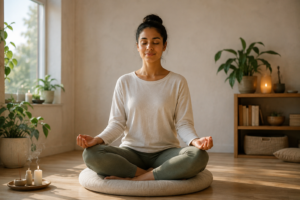
Sit on a chair, cushion, or meditation bench. You may also stand or use a walking practice when sitting is uncomfortable. Let the spine feel supported rather than rigid. Rest the hands wherever they can remain without effort.
Physical comfort matters more than looking traditional. Adjust your position when necessary. Meditation is not a contest to see how long you can ignore pain.
Step 3: Choose Whether Your Eyes Will Be Open or Closed
Closing the eyes can reduce visual distraction and encourage inward listening. Keeping them open can help you feel grounded and alert.
If your eyes remain open, rest your gaze softly on a neutral object or an area of the floor. Blink naturally. Choose the option that supports awareness rather than the one you think meditation is supposed to look like.
Step 4: Let Your Breathing Become Rhythmic
Allow your breathing to become comfortable and steady. You may breathe through the nose or mouth according to what feels natural and physically appropriate.
Do not force the breath to become unusually deep. Do not treat a count or breath hold as a test. Notice the movement of breathing and let it help settle the surface activity of the mind.
Readers who want additional options can explore these gentle breathing techniques for anxiety.
Step 5: Use Om or Another Point of Focus
Om is an ancient sacred sound that can help center awareness and quiet mental chatter.
You may silently repeat Om as you inhale and sound it gently as you exhale. You may also use a prayer, another sacred word, or a simple phrase such as “peace.” You may meditate without words and use the breath or a physical sensation instead.
The purpose is not to repeat sounds mechanically. It is to give the mind a spiritual direction and allow everything else to become quieter. For a deeper exploration, read Mantra Meditation: Benefits, Examples, and How to Begin.
Step 6: Observe Thoughts Without Following Them
Your mind will wander because that is what an active mind has been trained to do.
Notice where it went. Do not fight the thought, chase it, or condemn yourself for having it. Notice the thought as something appearing in awareness. You do not have to suppress it, believe it, solve it, or follow it.
Return to the breath, Om, or your chosen point of focus.
That return is the practice.
Each return helps the surface mind settle so you can recognize the stillness underneath it.
Step 7: Notice the Space Between Thoughts
As the mind settles, begin to notice the “space” between thoughts. Linger there. You may only experience seconds at first, but that’s enough. Over time, the space will expand. This stillness is your natural state beneath the noise.
Do not strain to manufacture the space. Let the mind settle, recognize the opening when it appears, and rest there for as long as it remains.
At first, you may notice only a second or two before another thought appears. Return to the breath, Om, or your chosen point of focus. As the surface activity settles again, notice the space once more.
That quiet is not foreign to you. It is part of your natural state beneath the mental noise.
What to Do Once You Are Meditating
Once the surface mind becomes quieter, you may remain in stillness, listen inwardly, pray, or guide thought intentionally. There is no requirement to fill the silence immediately.
Meditation, visualization, and manifestation can support one another, but they are not the same practice.
Meditation strengthens awareness. Visualization directs imagination. Manifestation joins thought and feeling with belief, choice, and action.
When you first become still, you are no longer creating only from habit and mental noise. You can choose more deliberately what you will accept, imagine, and energize. The article on using meditation as a tool for manifestation develops this spiritual practice further.
Healing Visualization and the Power of Belief
If you are living with pain or illness, you can use meditation to focus your imagination on healing.
- Envision a golden-white light surrounding and filling your body.
- See yourself healthy, energized, and strong.
- Feel complete well-being moving through every cell.
Faith and belief have played a meaningful part in many people’s healing experiences. Your imagination, when charged with belief, can be a powerful healing tool.
Use meditation and visualization as part of your healing journey while continuing any qualified care that is appropriate for you. Spiritual faith and practical support do not have to compete with one another.
Your First Three-Minute Meditation
First minute: Settle. Sit or stand in a position you can maintain. Let your eyes remain open or close them gently. Feel where your body meets the chair, floor, or ground.
Second minute: Choose and return. Rest attention on one anchor. Use the breath, a sound, Om, a word such as “peace,” or the feeling of your feet. When attention wanders, silently note “thinking,” “remembering,” or “planning,” and return.
Third minute: Listen inwardly. Notice what is present without requiring it to change. Before ending, ask:
“What quality do I want to carry into the next part of my day?”
Open your awareness to the room, move the body gently, and take one conscious action. The practice succeeds when you notice and return, not only when you feel peaceful.
When you want help choosing among different approaches, use Meditation for Stress and Anxiety: 7 Gentle Practices. For an especially brief anxious moment, try this quick meditation for anxiety.
Make Meditation a Daily Ritual
Even a few minutes can begin changing your relationship with attention. Some days you may settle quickly. Other days you may spend the whole session returning.
Both are part of the practice. What matters is that you return without turning meditation into another reason to criticize yourself.
The guide to meditating consistently without overcomplicating it can help you make the practice dependable.
When Meditation Feels Uncomfortable
If closing your eyes, watching the breath, or sitting still increases distress, open your eyes. Use an external sound or object. Sit in a chair. Move, walk, shorten the session, or choose a different anchor.
End the session when distress is escalating. Seek qualified support when anxiety, depression, trauma reactions, pain, or other symptoms persist or interfere with daily life. Choosing appropriate support does not weaken your spirituality or personal power.
Remember Who You Truly Are
Meditation is not about becoming someone else. It is about uncovering the peaceful presence that is already within you.
Some days you will touch that presence clearly. Other days, the practice will be one distracted minute followed by one conscious return.
Both count.
With time, you may begin to remember who you truly are beneath the noise.
Make time for it. You deserve it.
Reading the steps can help you begin, but a little guidance can make those first sessions feel much less confusing. A Beginner’s Guide to Meditation gives you practical support for quieting the surface mind, working with wandering thoughts, recognizing the stillness within, and developing a practice you can return to with confidence.
Discover more from Jepsen Mindset and Meditation Monk
Subscribe to get the latest posts sent to your email.
What’s Your Body Trying to Tell You?
Feeling tired, sluggish, bloated, or just not quite like yourself?
Sometimes it helps to stop guessing and take a closer look at your everyday wellness habits, nutrition, energy, and goals.

Take this FREE 2-minute Health Check and get recommendations based on your answers and what you want to improve.
No complicated forms. No pressure. Just a quick way to get a little more clarity about where you are—and what you may want to explore next.
Real Questions
Personalized Suggestions
ZERO Cost to You
A couple of minutes could give you a better idea of where to start.