3 Common Obstacles That Keep You Stuck—and How to Move Forward

Have you ever known exactly what you should do and still found yourself doing absolutely nothing?
You know the goal. You have made the plan. You may even have read three books, watched twelve videos, and created a beautiful list of everything you intend to do. Yet somehow you are still standing in the same place.
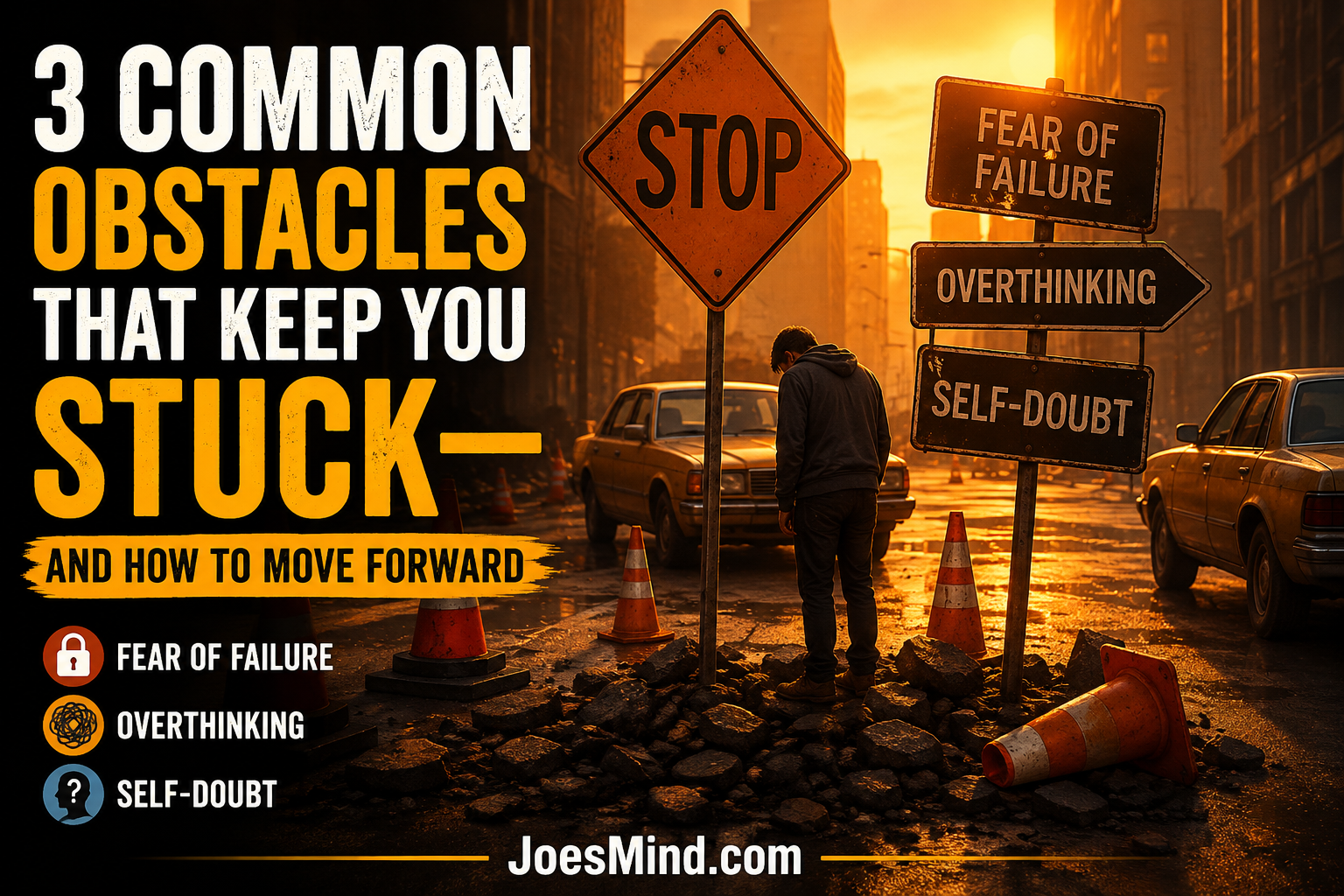
Sometimes the problem is not that we need more information. Sometimes something inside us keeps putting on the brakes. Fear of failure, overthinking, and lack of self-belief are three common ways we keep ourselves stuck even when part of us is ready to move forward.
The good news is that none of these has to make the decision for you. You can notice what is happening, question the story behind it, and choose a useful next step. If you already know what you want but need help turning it into action, my guide to setting meaningful goals and moving them into action is a good companion to this one.
1. Fear of Failure Can Make Doing Nothing Feel Safer
Fear of failure can show up as procrastination, avoidance, perfectionism, or self-sabotage. Sometimes we tell ourselves we are waiting for the right time when what we are really waiting for is a guarantee that nothing will go wrong.
There is no such guarantee. Failure can hurt. It can cost money. It can embarrass us. It can make us change direction. But none of that means failure has to become a verdict on who we are.
The goal is not to become fearless before you move. The goal is to stop giving fear the final vote. A reasonable step taken with some uncertainty is still a step.
Old belief: “I’m afraid I won’t be good enough.”
New belief: “I do not need a guarantee before I take the next reasonable step.”
If your fear is tangled up with old assumptions about what you can or cannot do, it may help to look at the difference between caution and fear-based hesitation in How to Overcome Self-Doubt Without Ignoring Good Judgment.
2. Overthinking Can Become a Substitute for Action
Thinking something through is useful. Planning is useful. Asking good questions is useful. But there comes a point when planning stops preparing you for action and starts protecting you from it.
That is analysis paralysis. You keep gathering information because making a decision feels uncomfortable. You revise the plan, compare more options, imagine more outcomes, and tell yourself you will begin as soon as you are completely certain.
Most worthwhile decisions do not arrive with complete certainty. At some point, you have to work with the information you have, make the best choice you can, and learn from what happens next.
When you catch yourself circling the same decision, ask: What information do I genuinely still need, and what am I pretending I need because I am afraid to act?
Old belief: “I need the perfect plan before I start.”
New belief: “I need enough of a plan to take the next step. I can adjust from there.”
Sometimes overthinking is fueled by a stream of worst-case thoughts. If that sounds familiar, challenging negative thoughts in a practical way can help you separate a useful warning from a story your mind keeps repeating.
3. Self-Doubt Can Turn Into an Identity
There is a big difference between “I am not sure I can do this” and “I am the kind of person who cannot do this.”
The first is uncertainty. The second is an identity.
Once you turn a temporary doubt into a definition of who you are, you start collecting evidence to prove the definition true. A setback becomes proof that you are incapable. Someone else’s success becomes proof that you are behind. One mistake becomes another reason not to try again.
This is where limiting beliefs become especially powerful. We can repeat an old story so often that it starts sounding like an objective fact. If you recognize that pattern, read 5 Common Limiting Beliefs Destroying Your Self-Confidence. The point is not to pretend you have no weaknesses. It is to stop confusing a current limitation with a permanent identity.
Old belief: “I’m not capable of achieving my goals.”
New belief: “I may not know how to do everything yet, but I can learn, adjust, and take the next step.”
When You Feel Stuck, Ask Yourself These Three Questions
- What am I afraid will happen if I move forward?
- What am I currently treating as a fact that may actually be an old belief or assumption?
- What is one useful action I can take in the next 24 hours?
You do not need to solve your whole life before dinner. Pick the obstacle that is actually in front of you and work with that one. A phone call, a written outline, ten minutes of research, one application, one honest conversation, or one small boundary can be enough to break the pattern of standing still.
Change the Inner Assumption, Then Move From It
Getting unstuck is not always about forcing yourself to work harder. Sometimes you need to notice the assumption you have been living from.
If your assumption is “I will fail,” you hesitate. If it is “I need to know everything first,” you keep preparing. If it is “I’m not capable,” every obstacle becomes evidence against you.
Change the assumption and you change the place from which you make your next decision.
That does not mean sitting on the couch imagining a different life and waiting for the Universe to deliver it to the front door. Choose the new assumption, feel into it, and then take the action that makes sense from that state.
“Assume the feeling of the wish fulfilled.” — Neville Goddard
Ready to Rewrite the Story Keeping You Stuck?
If the story keeping you stuck sounds like “I’m not enough,” “I can’t change,” or “this is just who I am,” Rewrite YOUR Life goes deeper into identifying limiting beliefs, questioning the old story, and consciously choosing a different direction.
Discover more from Jepsen Mindset and Meditation Monk
Subscribe to get the latest posts sent to your email.
What’s Your Body Trying to Tell You?
Feeling tired, sluggish, bloated, or just not quite like yourself?
Sometimes it helps to stop guessing and take a closer look at your everyday wellness habits, nutrition, energy, and goals.
Take this FREE 2-minute Health Check and get recommendations based on your answers and what you want to improve.
No complicated forms. No pressure. Just a quick way to get a little more clarity about where you are—and what you may want to explore next.
Real Questions
Personalized Suggestions
ZERO Cost to You
A couple of minutes could give you a better idea of where to start.