What Is Reflexology? Benefits, Evidence, and Safety

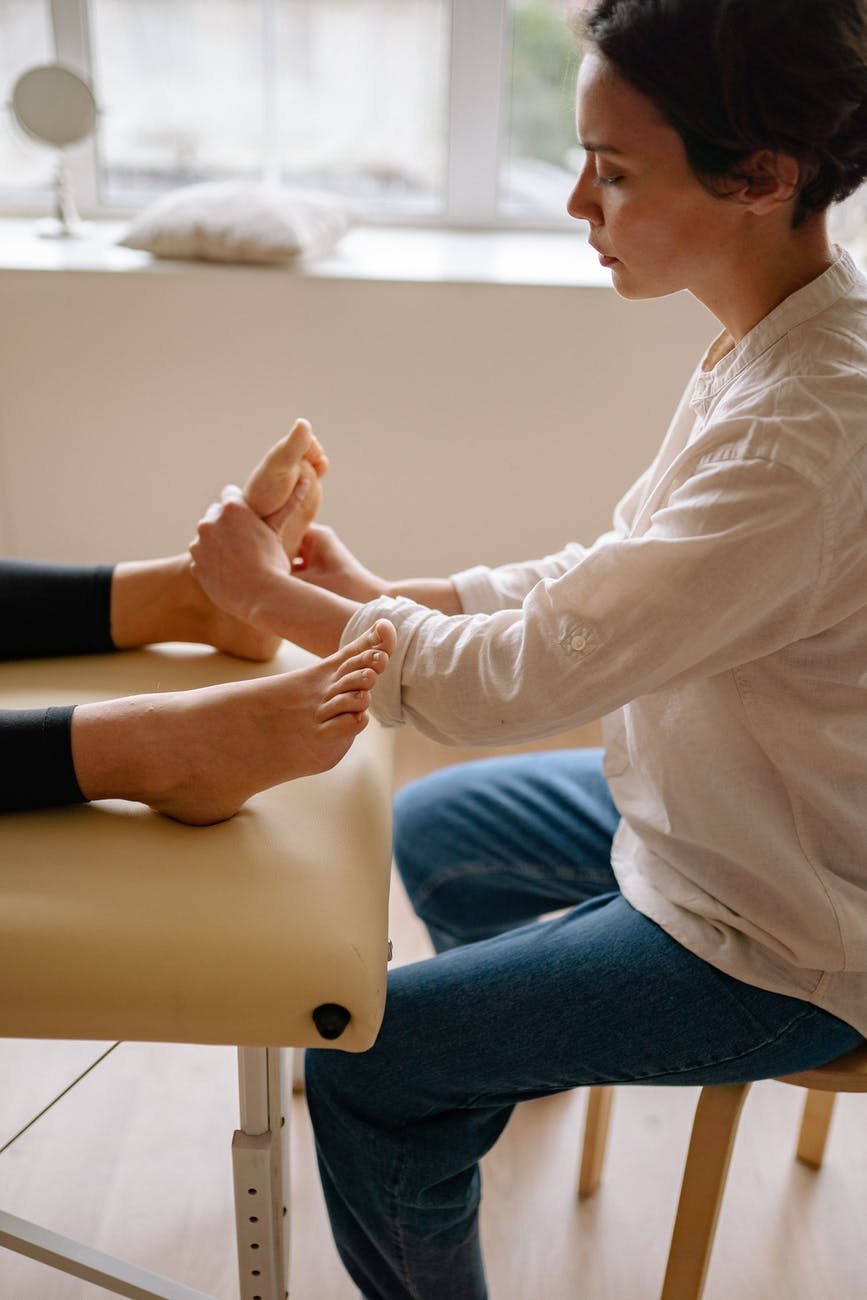
Reflexology is a complementary practice in which varying amounts of pressure are applied to areas of the feet or hands. Practitioners use traditional charts that associate these areas with other parts of the body.
Many people enjoy reflexology because the focused touch and quiet setting feel relaxing. However, the idea that pressing one area of the foot heals a corresponding organ has not been scientifically proven.
Reflexology can be explored as a personal relaxation or self-care practice without treating its traditional maps as medical anatomy or expecting it to diagnose or cure a condition.
How Reflexology Is Practiced
Reflexology is most commonly performed on the feet, although practitioners may also work with the hands.
During a session, you generally remain clothed except for shoes and socks. The practitioner uses their fingers and thumbs to apply pressure across different areas, often following a traditional reflexology chart.
Pressure should be adjusted to your comfort. A session may include rubbing, thumb movements, gentle holding, or massage-like techniques, but reflexology differs from an ordinary foot massage because its movements are guided by traditional zones and correspondences.
Understanding Reflexology Charts
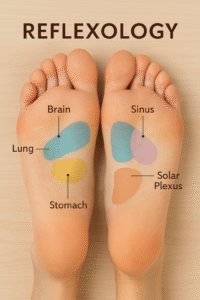
A reflexology chart divides the feet or hands into areas traditionally associated with parts of the body. For example, the toes may be labeled with areas associated with the head, while sections of the sole may be labeled with internal organs.
These labels represent the reflexology tradition. They should not be treated as scientifically established nerve pathways or diagnostic maps.
Tenderness in one area of the foot does not prove that the organ printed beside it is unhealthy. A reflexologist should not diagnose a medical condition from the location of a sensitive point.
For a gentle way to explore traditional charts without making medical promises, see Reflexology Tips for Beginners: A Safe, Simple Guide.
Traditional Ideas About Energy and Balance
Some reflexology traditions describe health through the movement of life energy, often called qi. Within that framework, pressure is believed to encourage balance and restore the free movement of energy.
These ideas may hold spiritual or personal meaning, but they are not established explanations of human anatomy or disease.
You can respect the tradition while distinguishing spiritual beliefs from medical evidence. Feeling calmer after a session is a valid personal experience, but it does not confirm that blocked energy caused an illness or that pressure healed an internal organ.
Why Reflexology May Feel Relaxing
Reflexology involves focused attention, physical touch, quiet time, and an opportunity to pause. Any of these may contribute to a feeling of relaxation or temporary comfort.
That experience does not have to be dismissed simply because the traditional organ maps remain unproven. At the same time, relaxation should not be confused with treating the underlying cause of a disease or injury.
A realistic goal might be to feel calmer, enjoy attentive touch, or create a restorative pause in your day.
What Research Shows
Broad systematic reviews have generally concluded that the clinical evidence for reflexology is limited. Many studies have involved small groups, weak controls, inconsistent methods, or outcomes that were difficult to separate from the general effects of massage, attention, and relaxation.
A systematic review of randomized trials concluded that the strongest available evidence did not convincingly show reflexology to be an effective treatment for any medical condition.
Research is not entirely uniform. Some condition-specific studies and reviews have reported symptom improvements. A recent review involving people with diabetic neuropathic pain reported reductions in pain and changes in quality-of-life scores, while also identifying heterogeneity and risks of bias among the included studies. Findings for one condition should not be generalized into claims that reflexology heals organs or treats disease broadly.
The most balanced conclusion is that some people may experience temporary relaxation or symptom improvement, but reflexology has not been proven to provide the wide-ranging healing effects often attributed to traditional reflex maps.
Readers considering reflexology for ongoing pain can find a fuller evidence discussion in Reflexology for Chronic Pain: What the Evidence Says.
What the Breast-Cancer Research Found
Reflexology has also been studied as supportive care for people receiving cancer treatment.
According to the National Center for Complementary and Integrative Health, an NCI-funded study involving women with advanced breast cancer found improvement in a few symptoms, including shortness of breath, but not pain or nausea. The study examined supportive symptom care—not whether reflexology treated the cancer or slowed its progression.
A later randomized trial of caregiver-delivered reflexology reported reductions in overall symptom severity and interference with daily activities, but it did not show improvements in functioning, social support, relationship quality, or satisfaction with life.
Reflexology should never be presented as cancer treatment or used in place of oncology care.
What Reflexology Has Not Been Proven to Do
Reflexology has not been proven to:
- Heal a distant organ by pressing a corresponding point
- Diagnose disease through tenderness in the feet
- Restore immune or endocrine function
- Increase oxygen delivery to internal organs
- Correct blocked nerve pathways
- Cure chronic pain or another medical condition
- Treat or slow the progression of cancer
Is Reflexology the Same as Foot Massage?
Reflexology and foot massage may use similar movements, and both may feel relaxing.
The main distinction is the explanation behind the movements. Massage generally focuses on muscles, soft tissue, comfort, and mobility. Reflexology follows a traditional map that associates areas of the feet or hands with other parts of the body.
Reflexology is also different from acupressure. Acupressure follows points and pathways from traditional Chinese medicine rather than reflexology’s foot-and-hand zone maps.
How to Approach Reflexology Safely
Use reflexology as a complement to appropriate care—not as a replacement for diagnosis, medication, physical therapy, cancer treatment, or another recommended service.
Tell the practitioner about relevant health concerns and ask them to keep the pressure within your comfort level. Do not allow anyone to pressure you into stopping medical care or purchasing repeated sessions with promises of a cure.
New, severe, worsening, or unexplained symptoms deserve evaluation by an appropriate healthcare professional.
Can You Practice Reflexology at Home?
You can explore gentle pressure on your own hands or feet as a relaxation practice. Keep the pressure comfortable and avoid interpreting tenderness as proof of an internal medical problem.
Research on self-administered reflexology remains limited. A review of self-administered reflexology studies reported some subjective improvements in stress, fatigue, or mood, but found little convincing evidence in objective measures and identified significant weaknesses in the available research.
The beginner guide provides a simple routine that does not make symptom-specific treatment promises. For another quiet self-care practice, you can also explore A Beginner’s Guide to Meditation.
A Practice You Can Explore With Clear Expectations
Reflexology can be appreciated without exaggerating what it can do.
You may value the focused touch, quiet attention, and sense of relaxation a session provides. You may also try it and decide that massage, meditation, or another form of self-care suits you better.
Let your personal experience and the available evidence work together. Enjoy what feels supportive, remain honest about the limits of the practice, and keep appropriate medical care at the center of important health decisions.
Ready to explore reflexology with clear guidance and realistic expectations? The Reflexology Starter Collection provides introductory explanations, traditional charts, and practical self-care resources to help you learn the practice at your own pace.
Discover more from Jepsen Mindset and Meditation Monk
Subscribe to get the latest posts sent to your email.
What’s Your Body Trying to Tell You?
Feeling tired, sluggish, bloated, or just not quite like yourself?
Sometimes it helps to stop guessing and take a closer look at your everyday wellness habits, nutrition, energy, and goals.
Take this FREE 2-minute Health Check and get recommendations based on your answers and what you want to improve.
No complicated forms. No pressure. Just a quick way to get a little more clarity about where you are—and what you may want to explore next.
Real Questions
Personalized Suggestions
ZERO Cost to You
A couple of minutes could give you a better idea of where to start.