Health Benefits of Meditation: What It Can Really Do for You

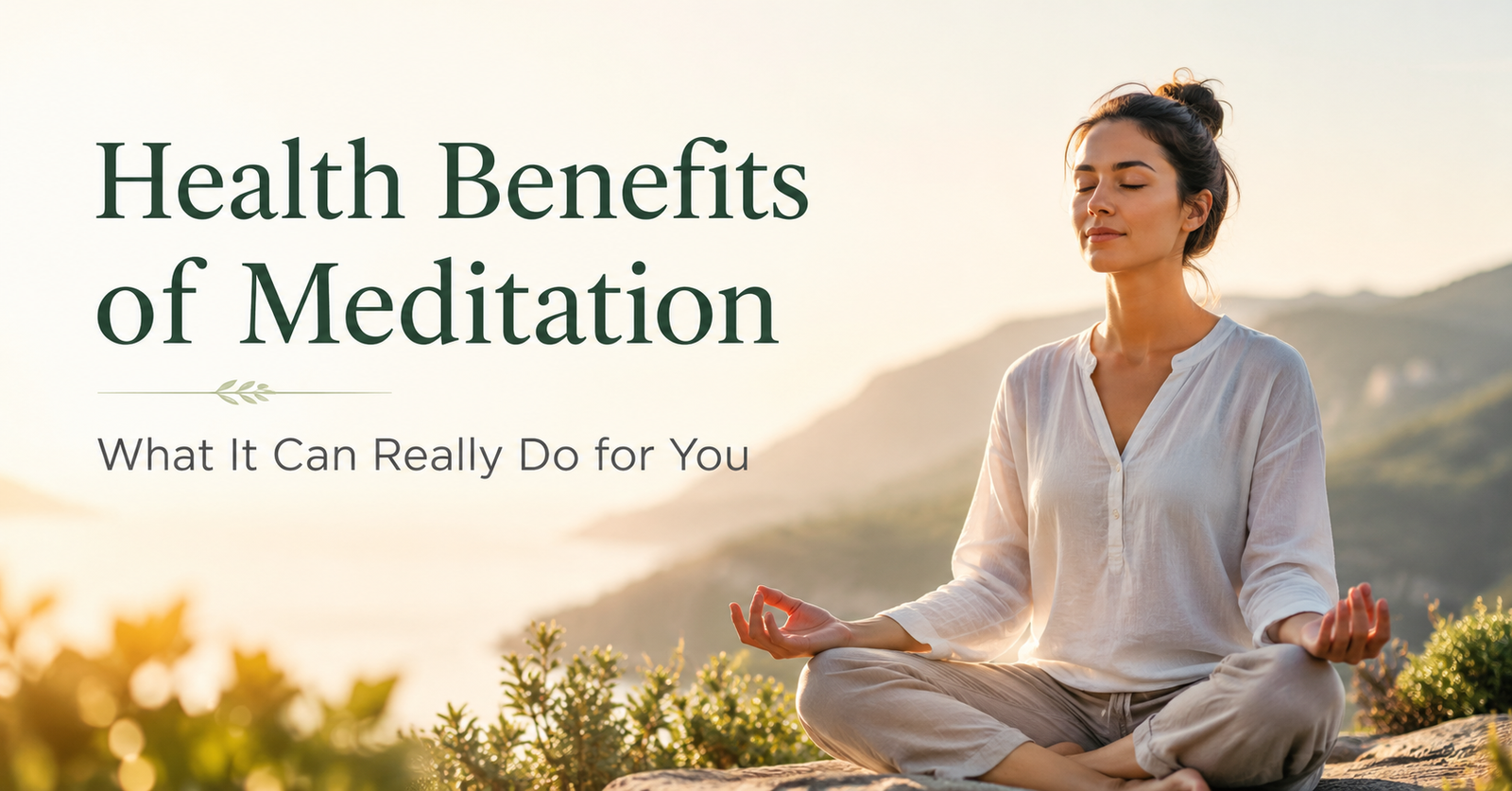
You do not have to become a monk, sit on a mountain, or somehow force your mind to go blank to benefit from meditation. Most people begin for much more ordinary reasons: stress, worry, poor sleep, a noisy mind, or simply the desire to feel more centered.
Meditation is not a magic cure. It is a practice of becoming aware of where your attention has gone and learning to bring it back deliberately. Research suggests that meditation and mindfulness may help in areas such as stress and anxiety, with possible benefits for pain, sleep, and blood pressure, although the strength of the evidence varies.
And there is another side to meditation that cannot be measured quite so neatly. It gives you an opportunity to become conscious of the inner state you are carrying into the rest of your life.
What Meditation Actually Is
Meditation is not the same thing as stopping every thought. Thoughts will show up. Sometimes they will arrive quietly, and sometimes your mind will act as if it has been waiting all day to hand you a complete inventory of everything you forgot to do.
The practice is noticing what is happening without automatically following every thought. You may use your breath, a word, a prayer, a visual image, a mantra, or simple present-moment awareness as a place to return your attention.
You also do not need one perfect posture or technique. Some people prefer silence. Others do better with a guided practice. If you are new to meditation, my seven-step guide to meditation gives you a simple place to begin.
What the Research Supports
Meditation has been studied for stress, anxiety, depression, chronic pain, sleep, blood pressure, and other health concerns. Some of that research is encouraging, but not every claim you hear about meditation is equally well supported.
That does not make meditation less valuable. It simply means we do not need to turn it into a miracle cure.
Stress and Anxiety
Mindfulness-based practices may help some people manage stress and anxiety. The National Center for Complementary and Integrative Health notes that research has found benefits in some studies, while results and study quality vary.
For me, that is a more useful way to look at meditation anyway. You are not trying to prove that you will never feel anxious again. You are learning how to notice the anxious state, create a little space around it, and choose what you want to do next.
If anxiety is what brought you to meditation, you may also find these three quick meditation practices for anxiety useful when you need help returning to the present.
Pain and Quality of Life
Research on chronic and acute pain is mixed. Meditation may help some people change how they relate to discomfort, improve coping, or support quality of life even when it does not make the pain itself disappear.
That distinction matters. There is a world of difference between saying, “This practice helps me live with what I am experiencing,” and promising that meditation will cure the condition causing it.
Sleep and Insomnia
Mindfulness meditation may help some people sleep better or reduce insomnia symptoms. The evidence is encouraging, but meditation has not clearly been shown to outperform established approaches such as cognitive behavioral therapy for insomnia or exercise.
That makes meditation a useful option to explore rather than a replacement for every other approach. If a racing mind is part of what keeps you awake, practicing how to notice thoughts without chasing each one may help you settle more easily.
Blood Pressure and Heart Health
Some research suggests meditation may have a modest benefit for blood pressure or cardiovascular risk, but the evidence is not strong enough to claim that meditation prevents heart attacks, strokes, or heart disease.
The American Heart Association has described meditation as something that may be considered alongside established heart-health practices, while emphasizing that the evidence remains limited.
In other words, meditation can be part of a healthier life. It should not be used as a substitute for appropriate medical care, medication, or other treatment when those are needed.
Meditation is generally considered low-risk, but it is not automatically comfortable for everyone. If a practice consistently increases anxiety, distress, or intrusive thoughts, try a different approach and consider qualified support when appropriate.
What Meditation Does Not Promise
Meditation does not guarantee perfect health. It does not prove that every illness began in your thoughts. It does not mean that someone who is sick failed to think positively enough.
What it can give you is a practice of awareness. You can become more conscious of the thoughts you rehearse, the stress you carry, the assumptions you repeat, and the way you respond to what life places in front of you.
That is where personal choice still matters. You may not control every circumstance, but you can practice choosing the state from which you meet it. Sometimes that means meditation. Sometimes it means rest, movement, a conversation, medical care, counseling, or simply admitting that today is harder than yesterday.
How to Make Meditation Part of Your Life
You do not need to make meditation complicated. Experiment until you find a practice you can actually return to.
- Start with a few minutes. There is no magic twenty-minute threshold you must cross before meditation becomes worthwhile. A short practice you repeat is more useful than an ambitious routine you avoid.
- Try a guided meditation. A voice, video, or audio practice can give your attention somewhere to return when you are still learning what to do with a busy mind.
- Choose a time that fits your life. Morning and evening work well for many people, but the best time is the one you will actually use.
- Go outside if nature helps you settle. A quiet porch, park, tree, or mountain view can make it easier to stop staring at the same four walls and remember there is a larger world around you.
- Use ordinary moments. You can practice awareness while walking, waiting, washing dishes, or sitting quietly before work. Formal meditation is useful, but presence does not have to end when the timer goes off.
If your schedule is the problem, How to Meditate If You Have a Busy Lifestyle offers more realistic ways to make room for the practice.
Everyone is different. Experiment with different techniques, times of day, and lengths of practice. Do not turn meditation into another test you can fail.
Experience the Change Before You See It
Meditation is often approached as something we “do” to get results. But the deeper power lies in becoming who we already are — peaceful, present, and whole.
“You must dare to assume you are what you want to be, and then live by faith in that assumption.” — Neville Goddard
Even if your thoughts race, or your to-do list nags at you, meditation works when you return — again and again — to stillness. That return is the practice.
Try this: before starting your meditation, take 10 seconds to feel what it would be like to already have the calm you’re seeking. Instead of waiting for the outside world to give you permission to feel peaceful, begin by touching that state within yourself.
If you want to explore that connection between meditation, feeling, and conscious creation more deliberately, Meditation for Manifestation: 5 Ways to Align Mind, Feeling, and Action takes the idea further.
Meditation isn’t about emptying the mind. It’s about refilling your life with presence.
That same inner space can help with more than stress. It can help you release old reactions and choose peace in relationships. If that is something you are working through, read How Meditation Can Help You Forgive.
Build a Practice You Can Return To
You do not need perfect silence, a blank mind, or an hour of free time. Start where you are. Notice where your attention has gone. Return it. Then return it again.
If you want a more structured way to begin without turning meditation into another chore, explore Mindful Meditation. It gives you a practical, spiritually grounded guide, checklist, mind map, and supporting resources you can work through at your own pace as you develop a practice that fits your real life.
Have you noticed a difference when meditation becomes part of your routine? Share what has helped you in the comments.
Discover more from Jepsen Mindset and Meditation Monk
Subscribe to get the latest posts sent to your email.
What’s Your Body Trying to Tell You?
Feeling tired, sluggish, bloated, or just not quite like yourself?
Sometimes it helps to stop guessing and take a closer look at your everyday wellness habits, nutrition, energy, and goals.
Take this FREE 2-minute Health Check and get recommendations based on your answers and what you want to improve.
No complicated forms. No pressure. Just a quick way to get a little more clarity about where you are—and what you may want to explore next.
Real Questions
Personalized Suggestions
ZERO Cost to You
A couple of minutes could give you a better idea of where to start.