5 Ways to Cultivate Inner Strength When Life Gets Messy

Life gets messy. Plans fall apart, relationships change, and sometimes the thing you counted on disappears without asking permission. Inner strength is not pretending none of that hurts. It is learning how to stay grounded enough to choose what you do next.
When this happens, one of the strongest things you can do is become the kind of person who can move through the mess without letting it decide who you are. This is the heart of resilience: trusting that you can respond, adapt, learn, and rise again.
From a New Thought perspective, where you place your attention matters. That does not mean every hardship was created by a bad thought. It means the thoughts, expectations, and actions you practice now can influence what you do next, what possibilities you notice, and what becomes possible from here.
The Tao Te Ching offers another way of looking at strength: not as constant resistance, but as learning when to act, when to yield, and when to stop fighting what cannot be forced. Inner strength can be firm without becoming rigid.
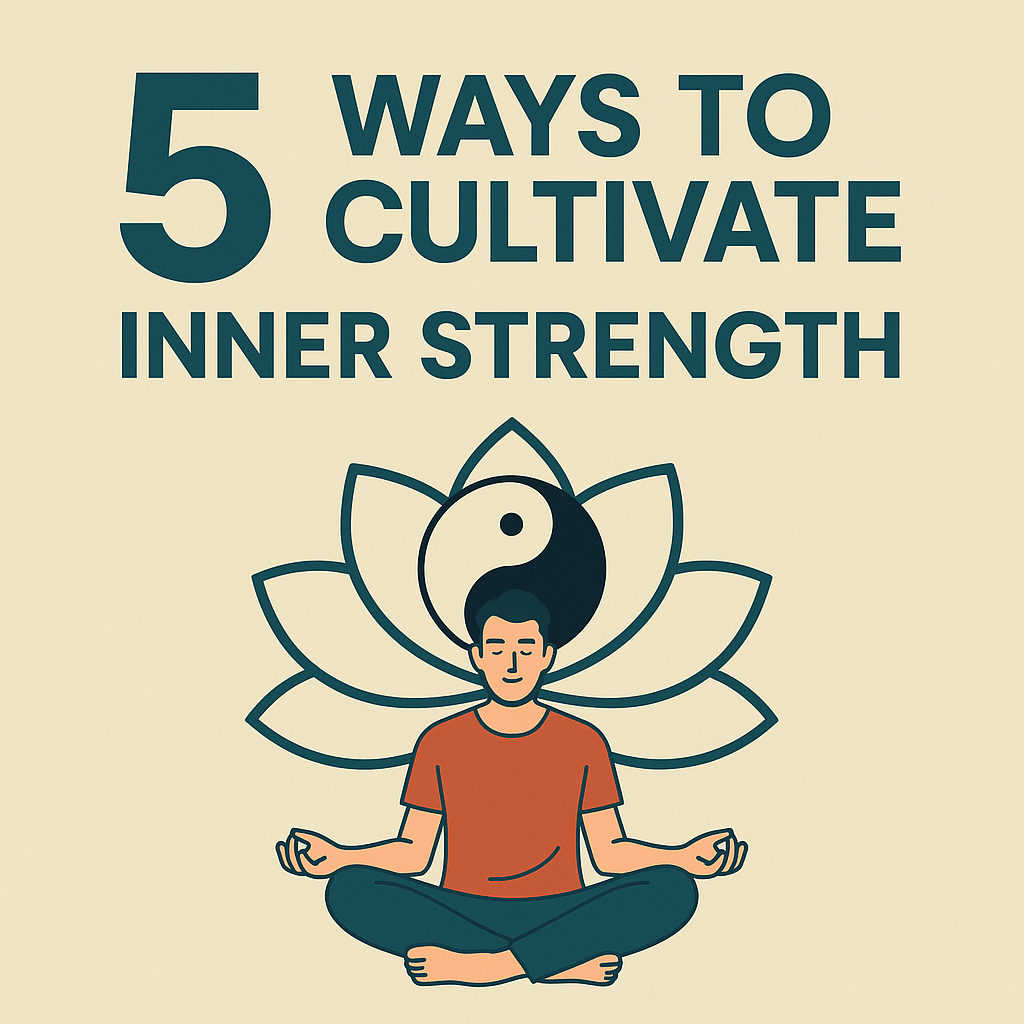
Here are five ways to cultivate that strength when life gets messy.
1. Accept What Is Out of Your Control
The first step toward inner strength is learning the difference between what can be changed and what must be accepted. Taoist philosophy repeatedly returns to the wisdom of not forcing what cannot be forced.
Acceptance is not approval, surrender, or pretending you like what happened. It is recognizing the facts you are dealing with so you can stop spending all your energy arguing with reality. From a Law of Attraction perspective, attention matters, but that does not mean you caused the situation simply by thinking about it.
Shift your attention toward what you can influence. If you fail a test, you can study differently next time, seek tutoring, or adjust your preparation strategy. But if someone ends a relationship and has no desire to reconcile, you cannot force another person to choose differently. You can choose what you do with your own life from there.
When you stop trying to control what is beyond your reach, you have more energy for the choices that are actually yours.
2. Create a Routine That Grounds You
A daily routine can be an anchor when life feels unpredictable. It cannot control the storm, but it can give you a few reliable points of contact with yourself. A routine is not about rigid control; it is about creating a rhythm that supports the person you want to be.
Taoist philosophy also embraces rhythm and natural cycles. Work, rest, connection, and solitude all have their place. You do not become stronger by forcing yourself to operate at full speed every minute of the day.
Your routine can be as simple as:
- Morning journaling to set intentions
- Preparing nourishing meals
- Spending time with uplifting friends
- A short daily meditation to center your mind
These small actions build familiarity and stability. When life gets chaotic, you already know where to return.
3. Set Boundaries to Protect Your Energy
Inner strength includes knowing where you end and other people begin. Healthy boundaries protect your time, energy, and peace without requiring you to control anyone else.
If you keep saying yes to things you do not want, resentment and exhaustion can build quietly. Sometimes strength looks less like pushing harder and more like deciding what you are no longer willing to carry. That is also where letting go of everyday energy drains becomes practical rather than philosophical.
The Tao often uses nature to show that structure and flow are not enemies. A riverbank gives water direction. In the same way, a boundary can create enough structure for your relationships and responsibilities to become more honest.
Practice saying “no” when no is what you mean. You can be kind without automatically agreeing. You can explain when explanation is useful, but you do not have to build a legal case every time you protect a reasonable limit.
4. Use Positive Self-Talk as an Inner Compass
Your inner dialogue matters, especially when circumstances are already difficult. A harsh internal story can make the next step feel impossible, while more deliberate language can help you remember your options, your values, and the person you want to be. If this is a pattern for you, learning to limit negative self-talk is a practical place to begin.
When life gets messy, it’s easy to let your inner critic take over: “I can’t handle this.” “Why does this always happen to me?” Instead, ask yourself: What would I say to a dear friend in this situation? Then offer yourself the same honesty and encouragement.
In James Legge’s translation of the Tao Teh King, Chapter 33 says, “He who knows other men is discerning; he who knows himself is intelligent.” Positive self-talk is not pretending everything is fine. It is learning to speak to yourself in a way that supports self-knowledge, conscious choice, and the next useful action.
5. Turn Challenges Into Growth Experiences
Difficult experiences can reveal things you might not have seen while life was comfortable: what matters, what no longer fits, what boundary was missing, or what strength needs to be developed. In Law of Attraction teaching, contrast can clarify what you do and do not want. The important part is what you choose to do with that clarity.
“Every subject is really two subjects: what you want and the absence of it. When you’re focused on the lack of what you want, you are still focused on the subject, but from the opposite end of the stick.” – Abraham-Hicks
Rather than treating every difficulty as punishment or proof that something has gone wrong with you, remember that hard life lessons can become material for spiritual growth without pretending the pain was necessary. Ask what can be learned, changed, accepted, or chosen from here. The useful questions are:
- What is this situation here to teach me?
- How can I respond in a way that reflects my highest self?
Reflection turns pain into progress. Keeping a “Lessons Learned” journal can help you see how past setbacks have shaped your growth.
Inner Strength Grows in the Next Choice
You are not defined by your setbacks, mistakes, or moments of weakness. Inner strength is not about never falling. It is about learning that even after a hard moment, you still have a next choice.
That choice might be to act, to rest, to ask for help, to set a boundary, to change your thinking, or to accept something you cannot undo. Strength does not mean doing everything alone, and it does not mean pretending pain is easy.
From a New Thought perspective, you can deliberately choose the inner state and direction you want to practice. From a Taoist perspective, you can learn when to move and when to stop forcing. Either way, inner strength grows through conscious response, not perfect control.
Life will get messy again. The goal is not to build a life where nothing goes wrong. It is to become someone who can meet the mess, remember who they are, and choose the next step with greater clarity.
Take the Law of Attraction Further
If this way of working with attention, expectation, and aligned action speaks to you, Master the Law of Attraction takes those ideas further with a more structured practice.
Discover more from Jepsen Mindset and Meditation Monk
Subscribe to get the latest posts sent to your email.
What’s Your Body Trying to Tell You?
Feeling tired, sluggish, bloated, or just not quite like yourself?
Sometimes it helps to stop guessing and take a closer look at your everyday wellness habits, nutrition, energy, and goals.
Take this FREE 2-minute Health Check and get recommendations based on your answers and what you want to improve.
No complicated forms. No pressure. Just a quick way to get a little more clarity about where you are—and what you may want to explore next.
Real Questions
Personalized Suggestions
ZERO Cost to You
A couple of minutes could give you a better idea of where to start.