How Positivity Can Change Your Life

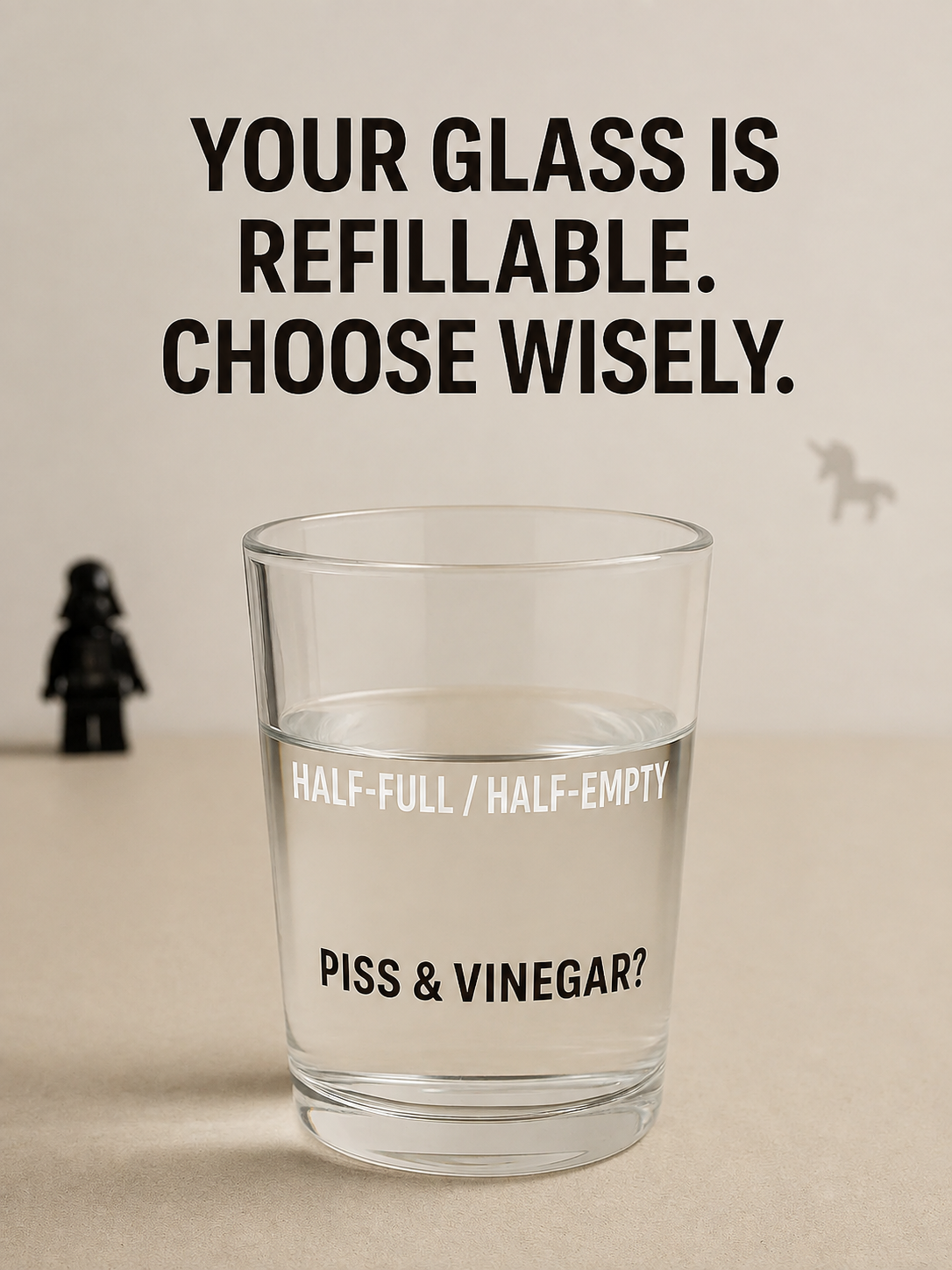
Is your glass half-full, half-empty—or does it just have piss in it?
You know the old question: “Is your glass half-full or half-empty?”
I think there’s a better answer.
The glass is refillable.
And what you keep pouring into it matters.
You can fill your mind with hope, gratitude, possibility, purpose, and solutions. Or you can spend every day topping it off with bitterness, blame, fear, and a little piss and vinegar.
That does not mean you control everything that happens to you.
It means you have a say in what you repeatedly do with what happens.
Positivity changes your life first by changing the direction of your attention. What you repeatedly notice affects what possibilities you see, what actions occur to you, what you expect from yourself, and how you respond when something goes wrong.
Positivity Changes What You Notice
Two people can walk through the same day and mentally collect completely different evidence.
One notices every delay, rude person, mistake, disappointment, and reason things are getting worse.
The other notices those things too—but also notices help, progress, opportunity, kindness, humor, and what can still be done.
Positive thinking does not erase reality.
It refuses to give the negative parts of reality exclusive ownership of your attention.
If you want practical ways to train that attention, start with 6 Ways to Become a More Positive Thinker.
Positivity Changes How You Respond to Problems
Positivity does not mean becoming emotionally bulletproof.
You can be disappointed and still ask what comes next.
You can be angry and still decide not to live there.
You can grieve what was lost and eventually begin imagining what might still be possible.
The difference is not whether an unwanted emotion appears. The difference is whether you allow that emotion to become the permanent conclusion.
When your mind keeps racing ahead to everything that could go wrong, 7 Ways to Stop Worrying About the Future can help you separate useful preparation from repetitive worry.
Positivity Changes What You Do Next
Expectation influences action.
If you are convinced nothing will work, why would you make the call, apply for the job, try again, have the conversation, change the habit, or take the first step?
A more hopeful expectation does not guarantee success.
It gives you a reason to participate in creating it.
That is an important distinction. Positive thinking is not a magic wand. It changes the posture you bring to your own life. You are more likely to look for a door when you believe one might exist.
Positivity Can Change Your Relationships
Your mindset changes what you bring into a relationship.
When you are less focused on criticism, resentment, and expecting the worst, you may communicate differently. You may listen better. You may notice what another person is doing right instead of keeping a running list of everything they do wrong.
That does not guarantee that every relationship becomes healthy.
Sometimes positivity includes having enough respect for yourself to set a boundary, stop participating in the same unhealthy pattern, or walk away.
Positivity and Your Health: Keep It in Perspective
There is evidence that optimism and positive psychological well-being are associated with better health outcomes, including cardiovascular health. A large meta-analysis of optimism and cardiovascular outcomes found meaningful associations, and the American Heart Association has also discussed positive psychological health as one part of cardiovascular well-being.
That does not mean positive thinking prevents illness or that somebody became sick because they failed to think positively.
Mindset is one part of a much larger picture that can include genetics, environment, medical care, habits, stress, relationships, and circumstances beyond our control.
What positivity can do is support choices that move us toward greater well-being.
Positivity Is Not Pretending Everything Is Fine
There is a version of “positive thinking” that I have no use for.
Something hurts, and somebody tells you to smile.
You lose someone, and somebody immediately tells you everything happens for a reason.
You are struggling, and somebody acts as though acknowledging the struggle is somehow spiritually defective.
That is not what I mean by positivity.
You can acknowledge pain without building your home inside it.
You can admit something is wrong while still believing something better is possible.
Truth first. Then direction.
What Are You Refilling the Glass With?
The glass is refillable.
That means yesterday’s bitterness does not have to be today’s drink.
Neither does yesterday’s fear, failure, resentment, disappointment, or somebody else’s opinion of you.
You may not get to choose every ingredient life hands you.
But you can become much more conscious of what you keep pouring back into your own mind.
- Gratitude.
- Possibility.
- Faith.
- Better expectations.
- A willingness to try again.
And sometimes just enough humor to look at the glass and say, “Well, at least it doesn’t have to stay full of piss.”
Refill wisely.
If you want to keep developing that direction deliberately, Happiness Is a State of Mind: 5 Ways to Cultivate More Joy explores another side of the same practice.
Ready to Change More Than a Few Thoughts?
Sometimes negativity is not just a passing thought. It is tied to an old story about who you are, what always happens to you, and what you believe is possible.
Rewrite YOUR Life is designed to help you examine those limiting stories and begin deliberately choosing a different direction for your life.
Discover more from Jepsen Mindset and Meditation Monk
Subscribe to get the latest posts sent to your email.
What’s Your Body Trying to Tell You?
Feeling tired, sluggish, bloated, or just not quite like yourself?
Sometimes it helps to stop guessing and take a closer look at your everyday wellness habits, nutrition, energy, and goals.
Take this FREE 2-minute Health Check and get recommendations based on your answers and what you want to improve.
No complicated forms. No pressure. Just a quick way to get a little more clarity about where you are—and what you may want to explore next.
Real Questions
Personalized Suggestions
ZERO Cost to You
A couple of minutes could give you a better idea of where to start.