Reflexology for Colds: A Gentle Self-Care Routine for Comfort

A miserable head cold can make almost any kind of comfort sound appealing.
Reflexology is one practice some people turn to when they are congested, tired, tense, and simply want to feel a little better while their body works through the illness.
Reflexology is based on the traditional idea that areas of the feet and hands correspond with other areas of the body. Practitioners use pressure and massage on those points as part of the practice.
It is important to separate that tradition from what has actually been proven.
There is not good evidence that pressing a point on your foot treats your lungs, clears a sinus infection, strengthens your immune system, or cures a cold.
That does not mean a gentle reflexology session cannot feel relaxing or comforting.
And sometimes comfort is exactly what you are looking for when your nose is stuffed up and you feel lousy.
1. What Reflexology Can and Cannot Do for a Cold
Reflexology should be thought of as complementary self-care, not as a treatment for the virus itself.
The National Center for Complementary and Integrative Health describes reflexology as a practice in which pressure is applied to areas of the feet or hands that are believed to correspond with other parts of the body. It also notes that the claimed healing effects in those corresponding organs have not been proven.
That distinction matters.
You can enjoy reflexology as a relaxing practice without asking it to do a job it has not been shown to do.
If you are new to the subject, What Is Reflexology? Benefits, Evidence, and Safety gives you the larger picture of the practice and what the research does and does not support.
2. Three Traditional Reflex Points to Explore
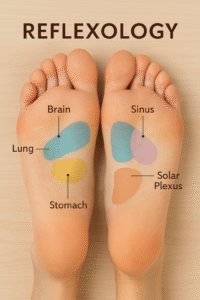
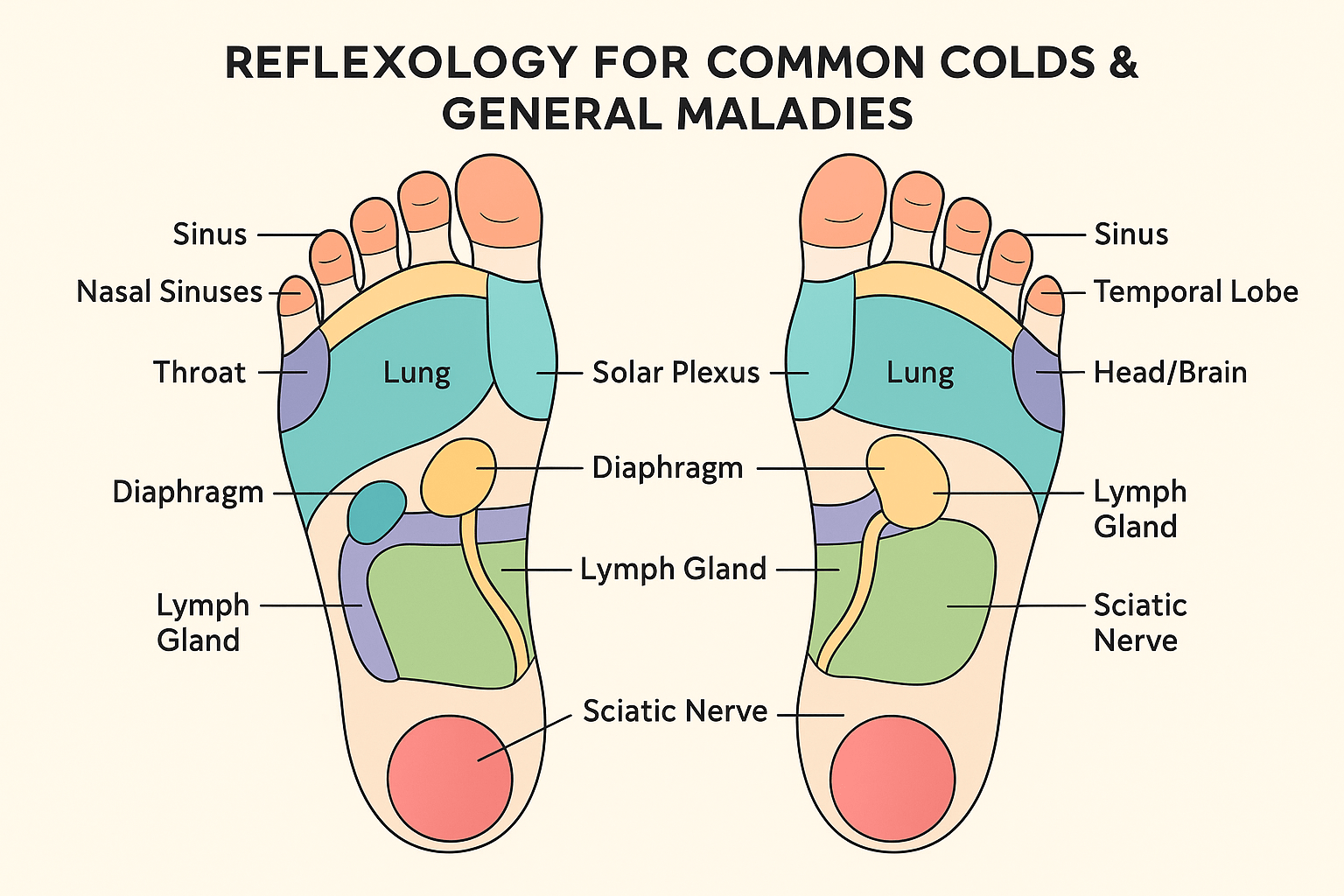
Traditional reflexology charts associate certain areas of the feet with the lungs, nose, and sinuses.
These relationships are part of reflexology theory. They have not been established as anatomical connections, so I would not think of pressing these points as physically treating your lungs or sinuses.
Instead, approach this as a gentle self-care practice.
Pay attention to how the pressure feels. Notice whether it helps you relax. And do not worry about doing it perfectly.
The Lung Area
In traditional reflexology mapping, the broad area beneath the three middle toes is associated with the lungs.
Place your thumb on that area and massage gently, either moving slowly up and down or using small circular movements.
You can also wrap your fingers around the foot and use both thumbs to cover the area gradually.
Start with about 30 seconds on each foot. If it feels comfortable, you can gradually work up to about a minute.
The Nose Area
Reflexology charts traditionally place the nose-related area along the outside edge of the big toe.
Because this is close to the nail and nail bed, use light pressure and do not work over irritated, injured, or painful skin.
Support the toe with your fingers and massage gently with the pad of your thumb, moving slowly from side to side for about 30 seconds.
The Sinus Area
The rounded upper portion of the big toe is commonly associated with the sinus area on reflexology charts.
Use your thumb and forefinger to massage it gently from side to side for about 30 seconds on each foot.
None of this needs to hurt.
More pressure is not automatically better.
If you are still learning how much pressure feels appropriate, Reflexology Tips for Beginners: A Safe, Simple Guide is a good place to start.
3. Use Reflexology Alongside Ordinary Cold Care
A common cold usually needs time more than anything else.
Rest. Drink enough fluids. Use humidified air or saline if those help you. Give your body room to recover.
Then, if reflexology feels relaxing to you, add a few minutes of gentle foot work.
You do not have to choose between ordinary self-care and complementary practices.
One can support the other as long as you keep your expectations realistic.
4. Know When It Is More Than a Simple Cold
Reflexology is not a substitute for medical care when something more serious may be going on.
If your symptoms are severe, getting worse instead of better, accompanied by trouble breathing or significant wheezing, involve a high or persistent fever, or simply are not improving as expected, contact a qualified healthcare professional.
Part of good self-care is knowing when a home comfort practice is enough and when it is time to get help.
Pay Attention to Your Own Response
If you are just beginning to practice reflexology on yourself, take your time getting to know it.
Notice what feels soothing and what does not.
Notice areas that feel tender and reduce the pressure rather than trying to force your way through discomfort.
Notice whether a few quiet minutes of foot massage helps you relax when you are tired, stuffed up, and irritable.
You do not need to prove that a point on your foot changed an organ somewhere else in your body in order to value the experience.
Sometimes a gentle practice is worthwhile because it gives you a few minutes to slow down, breathe, and care for yourself.
If you want to explore reflexology beyond this simple cold-comfort routine, the Reflexology Starter Collection gives you a broader introduction to the practice and practical ways to begin using reflexology for yourself.
Discover more from Jepsen Mindset and Meditation Monk
Subscribe to get the latest posts sent to your email.
What’s Your Body Trying to Tell You?
Feeling tired, sluggish, bloated, or just not quite like yourself?
Sometimes it helps to stop guessing and take a closer look at your everyday wellness habits, nutrition, energy, and goals.
Take this FREE 2-minute Health Check and get recommendations based on your answers and what you want to improve.
No complicated forms. No pressure. Just a quick way to get a little more clarity about where you are—and what you may want to explore next.
Real Questions
Personalized Suggestions
ZERO Cost to You
A couple of minutes could give you a better idea of where to start.